Resilience Through Storytelling: How The Outsiders Gives Voice to Marginalized Youth and Inspires Across Generations

Written by Ayanna Prescod
At a glance
- The Outsiders was written in 1967 by S.E. Hinton when she was 16 years old and living in Tulsa, Oklahoma.
- The novel examines class divisions through the rival groups known as the Greasers and the Socs.
- Nearly six decades later, the story has been adapted into a Broadway musical now on its first North American tour.
- The 2024 Broadway production won four Tony Awards, including Best Musical.
Hinton reflects on the novel’s characters, legacy, and evolution from page to stage.
In 1967, a 16-year-old from Tulsa, Oklahoma, quietly shifted the landscape of American literature. Susan Eloise Hinton, known more publicly as S.E. Hinton wrote The Outsiders from her bedroom while still in high-school. What began as a response to the fractures she observed among her peers—the invisible line between those with privilege and those without—became a novel that would ripple across generations, offering a mirror for people who felt overlooked, misunderstood, or out of place.
Almost sixty years later, that story still speaks. Its latest iteration, a Broadway musical now also underway on its first North American tour, proves the endurance of Hinton’s vision: narratives rooted in resilience not only survive, but thrive, because they give voice to those who most need to be heard.
When asked what sparked The Outsiders, Hinton is matter-of-fact: “I was inspired by my high school. I just got tired of all the social classes fighting each other.” What began as a short story after a friend was attacked grew into something larger than even she imagined.
Hinton never expected the book to resonate decades later, but as she recalls, “It never went out of print. They kept selling better every year.” That steady hum of connection—from readers in 1967 to audiences discovering Ponyboy Curtis on Broadway and film—reveals something timeless about the divisions she captured. “If you have ten kids in a school, they will divide up into the in group and the out group,” she explained. “That does not change. [But also] not every Greaser is a hero, and not every Soc is a villain. That’s true in life too.”
The Greasers and the Socs may belong to Tulsa in the 1960s, but the dynamics of us versus them, wealth versus struggle, and power versus vulnerability are in fact universal. That universality is precisely why the novel has endured: while the labels shift with each generation, the humanity of the characters remains, growing alongside the readers, and even with Hinton herself.
Though written by a teenager, The Outsiders has matured alongside its readers. For Hinton, Ponyboy has always felt the most personal. “None of my characters’ lives have been like mine,” she reflected. “But Ponyboy has always felt closest.” His curiosity, love of books, and imagination mirrored her own. “I like to read. I like to imagine. He’s very much like me.” Yet Johnny also lingers in her mind, not because he reflects her directly, but because he embodies so many young people she has encountered since the novel’s publication. “Johnny reminds me of so many kids I’ve met since the book was published,” she said, underscoring how the characters continue to connect with real lives beyond the page.
And the impact of these characters and the text has been profound. For nearly six decades, Hinton has received letters from readers who repeat the same confession: I never finished a book before yours. For many, The Outsiders is not simply a novel—it is the gateway into literature itself, the first story that made them feel seen, the first book they couldn’t put down. That matters deeply to Hinton. “This book has been such an important part of my life,” she reflected. “Glad to turn anybody on to reading.” In this way, the book doesn’t just tell a story of outsiders; it pulls new readers inside the world of words and imagination.
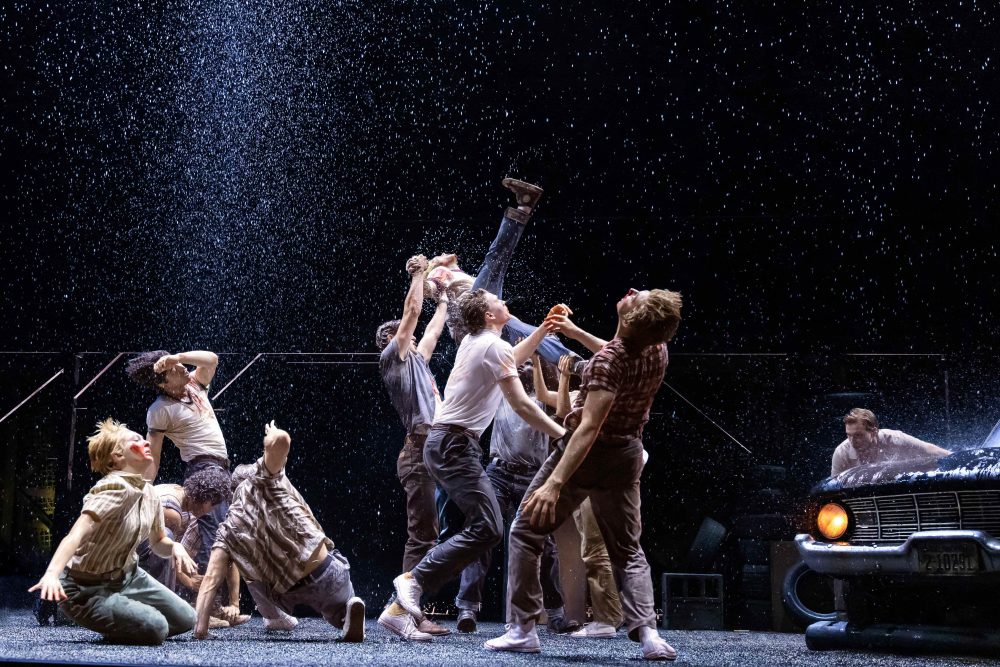
The longevity of The Outsiders has fueled a legacy of adaptations, each one reshaping the story for a new generation. Francis Ford Coppola’s 1983 film cemented its place in pop culture, while school and regional stage productions have kept its themes alive in classrooms and communities across the country. But it is the Broadway musical—winner of four Tony Awards in 2024, including Best Musical—that has brought the tale full circle, marrying Hinton’s raw honesty with the visceral power of live performance. The production has been praised for capturing both the grit and the tenderness of her original text, something Hinton herself deeply appreciates. “I love the musical,” she said warmly.
For Hinton, the most striking moment on stage was the rumble, a scene she described with cinematic detail in the novel but which takes on new urgency through the musical’s gritty fight choreography and modern score. “I thought the rumble was great,” she admitted. “It just brought every piece of [my book’s] description to life.”
That translation from page to stage does more than add spectacle—it reshapes how we experience the characters themselves. Ponyboy’s interior world, once confined to narration, becomes a living, breathing presence when voiced through music. His songs sharpen his identity as both a dreamer and an outsider, underscoring his yearning for beauty amid chaos. As Hinton noted, “It was really good because it showed how much he identified with the book,” referring to the poignant staging of Ponyboy clinging to Great Expectations.
“The musical stayed very close to the book and true to the characters,” she said. “Naturally, I am pleased about this. I believe the music provides insight to the characters. I like that some people will experience the story for the first time as a musical, and then they read the book or see the movie.”